Substantive Post #2: Models of Active Learning
By watching the Historia video, I was struck by how those sixth graders were actively debating their points and forming alliances. It reminded me of my own high school history class, where we spent 40 minutes copying bullet points from a PowerPoint in dead silence. I was a passive receiver of information. In Historia, students become active creators of their own country’s history. This simple contrast shows how active learning models can turn dry content into engaging experience.
Theory in Action: More Than Just “Play”
This week’s readings showed me that good learning doesn’t happen by accident. Historia works because it’s well-designed. Two frameworks helped me understand why.
First, the ICAP Framework explains different levels of thinking in learning. To understand why Historia is so effective, it helps to use this framework. This theory says that deeper thinking leads to better learning, and it describes four levels of engagement:
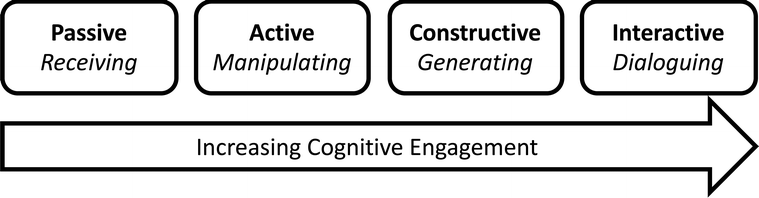
Figure 1: The ICAP Framework shows how cognitive engagement increases from Passive to Interactive. (Source: Chi and Willie (2024))
Now, let’s place our two learning environments on this framework. The table below sorts typical activities from a traditional classroom and from the Historia game-based learning experience into these ICAP levels.
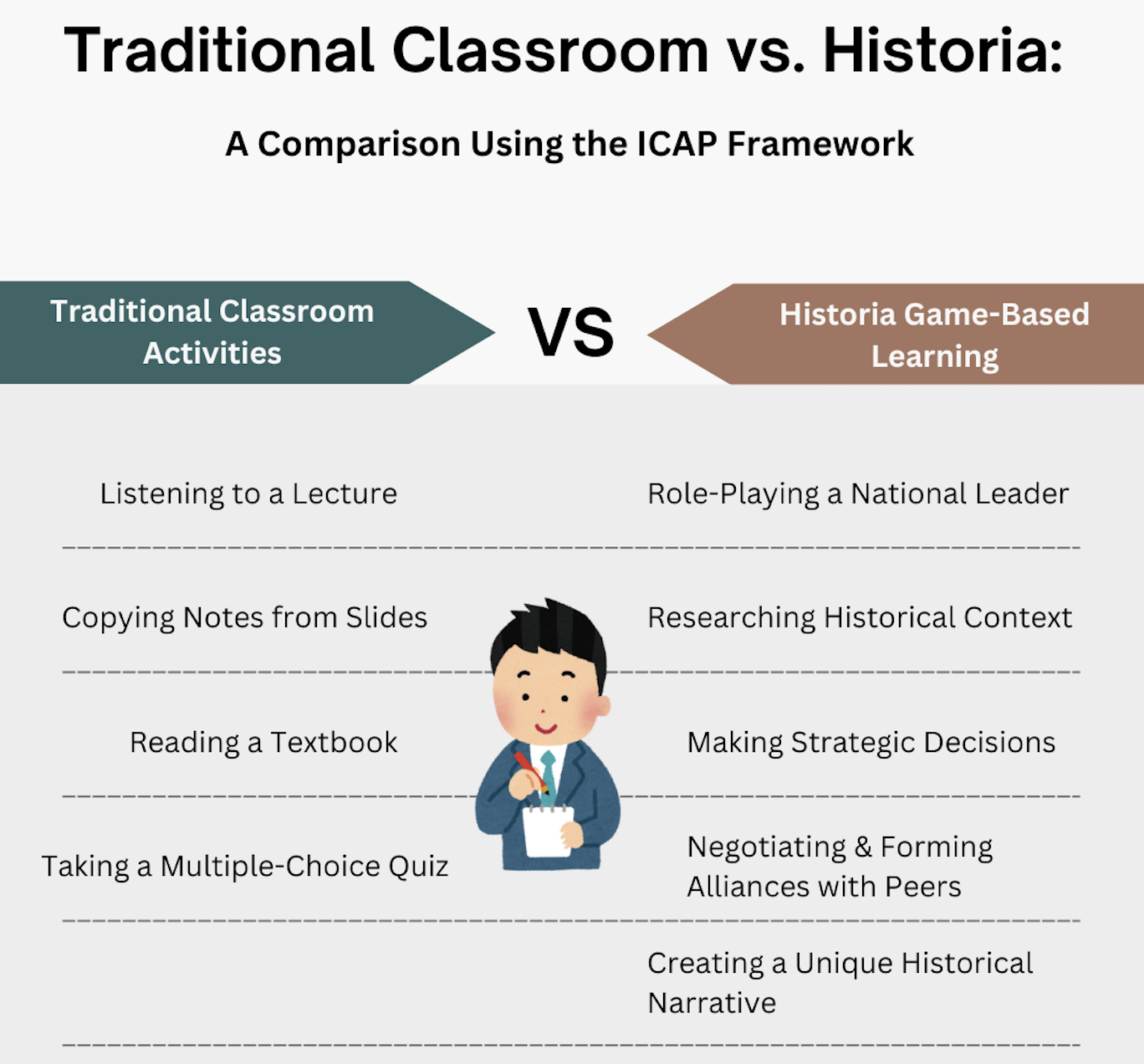
Figure 2: My analysis of where common activities from both learning models fall within the ICAP Framework.
I created this table to make the abstract ICAP theory concrete. By categorizing specific activities, we can visually see how Historia shifts learning from lower to higher cognitive engagement. The visual comparison is striking. Traditional classroom activities cluster heavily on the left side (Passive and Active levels), where students receive and manipulate information given to them. In contrast, Historia’s design pushes students to the right side (Constructive and Interactive levels), where they must generate their own understanding and engage in dialogue to solve problems. This shift from a consumer of history to a producer of historical outcomes is the core of its active learning ability.
Second, Merrill’s Principles of Instruction say learning should start with a real-world problem. Historia activates prior knowledge and lets students apply and integrate what they learn by making decisions and facing consequences. But the video also mentioned the game was too hard at first. That’s a reminder: before application, students need a good demonstration. Without enough historical context, their choices might just be guesses.
Personal Reflection and a Design Idea
Reading Students Need to DO Something made me feel very familiar. The story about the child learning weather systems with only a textbook, no role-play or simulation, which similar to my own experience. The author’s main point is that we often skip the guided practice step. We jump from instruction to independent work (or a test) without letting students “do” anything with the material first.
So, how could we use multimedia to enhance a “low-tech” game like Historia? The goal isn’t to make it flashy, but to use media to fill gaps in the learning process, especially Merrill’s demonstration principle.
Here’s my idea: add a “Historical Advisor” module to the game. This could be a simple interactive timeline or story map (made with tools like ArcGIS StoryMaps, which is listed in our course readings as an expressive platform). When students face a big decision (like whether to enter a war), they could click open this module. Instead of giving answers, it would use short video clips, historical images, or audio diaries from different perspectives (a king, a farmer, a soldier) to show the context of the time. This turns their “research” from pure text reading into a multi-sensory, multi-perspective investigation. They’d make more informed decisions, not just guesses.
A Note on My Use of Generative AI
For this post, I used generative AI as a learning and thinking aid, following our course guidelines.
1. Before drafting: I asked AI to explain the ICAP framework and Merrill’s principles in simple terms. This helped me clarify the difference between “constructive” and “interactive” engagement.
2. After my first draft, I asked AI to give me feedback based on the rubric. It suggested I add more specific personal examples (so I included my high school history memory) and make sure my multimedia ideas connected to my argument (which led me to describe the “Historical Advisor” idea in detail).
3. All core arguments, personal stories, reflections, and the final writing are my own. The AI was used only for understanding concepts and getting feedback on structure.
Conclusion
Historia and this week’s readings taught me a clear lesson: good teaching isn’t about using the fanciest technology. It’s about designing experiences using models like ICAP and Merrill’s principles. Even without high technology, if we design lessons where students do, build, and interact, we can transform a classroom from a place of passive listening into a workshop of active learning. My goal is to be that kind of learning designer, not just a presenter of slides.